Creator Publishing & Channel Integrity
YouTube Shorts originality audit: what creators should check before publishing
A practical YouTube Shorts originality checklist that separates recommendation, monetization, copyright and spam-policy decisions before upload.
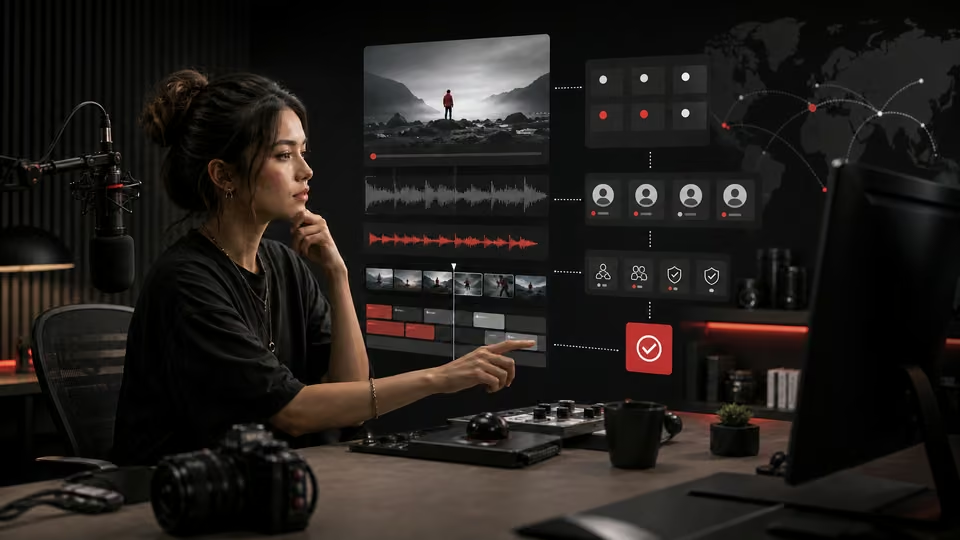
The decision before upload
YouTube's October 1 update gives creators a clear direction: Shorts recommendations will further prioritize original content and may reduce distribution for videos reuploaded from other creators without meaningful added value. The practical response is not to guess how many cuts, captions or effects will satisfy an algorithm. It is to make the creator's contribution visible, preserve the source and rights record, and separate four decisions that are often confused: recommendation, monetization, copyright and platform integrity.
What changed—and what did not
YouTube's official creator-community post says its recommendation systems are being updated to prioritize original Shorts and reduce the reach of content that primarily reuploads another creator's work without adding anything meaningful. It points creators toward original commentary, unique editing and storytelling when they use third-party clips.
That announcement is a recommendation signal, not a numeric originality score and not a promise that a qualifying video will receive more reach. YouTube does not publish a safe percentage of new footage, a minimum commentary duration or a required number of edits. A creator should therefore avoid claims such as “30% original footage is enough” or “adding voiceover makes every clip transformative.”
The update also does not replace the channel monetization policy. YouTube's current policy says monetized content should be original and authentic, and reviewers may look across the channel's main theme, newest and most-viewed videos, watch-time concentration, metadata and About section. Reused-content review is channel-level and is separate from copyright enforcement. A creator may have permission to use a source and still fail a reused-content review if viewers cannot see a meaningful difference.
Keep four release questions separate
Use one row for each decision. A green answer in one row does not automatically clear the others.
Fair use belongs inside the copyright row, not above the whole table. YouTube's official guidance notes that fair use varies by jurisdiction and depends on the facts of each case. Platform tools and automated checks cannot provide a universal legal clearance. When the use is material or disputed, get qualified advice rather than presenting an internal checklist as a legal conclusion.
- Question — What it asks — Evidence to keep — Common mistake
- Recommendation originality — Does the Short add a distinct creator perspective or experience? — Script, commentary track, edit map, creator-shot footage — Treating minor crops, speed changes or captions as meaningful transformation
- Monetization authenticity — Does the channel consistently offer varied, original viewer value? — Channel sample, format variation, production notes, About description — Reviewing one Short while the surrounding channel remains repetitive or mass-produced
- Copyright and permission — Do you have a defensible basis to use every protected asset? — License, platform remix record, written permission, source URL, jurisdiction note — Assuming monetization approval, credit or public availability equals permission
- Spam and integrity — Is the workflow avoiding scraping, mass production, detection evasion and misleading metadata? — Tool log, batch size, human review, title/thumbnail check — Using automation to produce many interchangeable videos or disguise copied media
Build a five-file originality evidence pack
The goal is not paperwork for its own sake. A small, repeatable file makes the creative decision visible and improves handoffs between creator, editor, manager and brand.
1. Source inventory
List every clip, image, music track, voice, template and generated element. Record the source URL or project location, owner, acquisition date and intended use. Mark creator-shot material separately from platform remix assets, licensed libraries, public-domain material and third-party clips.
2. Contribution map
Describe what the creator adds that would still matter if the borrowed clip disappeared. Examples include a documented experiment, expert explanation, criticism, comparison, original reporting, a new narrative or creator-shot demonstration. “Added captions,” “changed speed” and “used a different song” describe editing actions; they do not by themselves explain new viewer value.
3. Rights basis
For each non-original asset, record the permission or legal basis being relied on, the market, duration, edit allowance, monetization scope and any attribution requirement. A platform remix feature, a direct license and a fair-use position are different bases and should not be collapsed into one “cleared” status.
4. Variation proof
Compare the Short with the channel's recent output. If the hook, visuals, script structure and conclusion can be swapped across ten videos with only a noun changed, the production may look templated even if each file is technically new. Record the distinct question, evidence, story or demonstration that makes this episode worth watching.
5. Final release snapshot
Save the approved export, title, description, thumbnail, disclosure choices and named reviewer. Confirm that the public packaging delivers what the Short actually contains. If a brand is involved, keep the commercial disclosure and usage-rights record with the same release file, but do not treat brand approval as YouTube policy approval.
Clip compilation
Stop when the value is mainly the selection or sequence of other people's clips. Revise by adding a clear analytical question, original reporting, comparative framework or creator-shot demonstration that changes the viewing experience. Keep the source and rights record for every clip.
Reaction or commentary
Showing a face beside a video is not automatically meaningful commentary. The creator should explain, challenge, teach or reinterpret something specific. Remove long stretches where the borrowed content carries the entire experience and the creator adds only gestures or generic approval.
Template-led series
A repeatable format can be legitimate; YouTube's monetization guidance allows recurring structures when the substance varies and each video provides distinct value. The review question is whether the episode has a new problem, evidence and conclusion—not whether the same intro, typography or visual system appears again.
AI-assisted production
AI can help with scripts, editing or visuals, but automation does not remove the originality requirement. YouTube's spam policy warns against automated or synthetic mass production of similar content with minimal changes. Keep a human editor, source verification and a batch stop rule. If three drafts become interchangeable, pause production and redesign the premise before scaling.
Run a three-Short acceptance test
For the next three uploads, complete the same sequence:
The strongest operating outcome is not a speculative algorithm hack. It is a channel where the creator's role is obvious, source use is accountable, episodes are meaningfully varied and a brand partner can understand what was made and who approved it.
KOLMKT recommends using this audit before a clip-led Short enters a sponsored brief or a scaled production queue. Run it on the next three uploads, then use the campaign-readiness check to decide whether the channel evidence is strong enough for a brand collaboration.
- Write the viewer value in one sentence before editing.
- Complete the source inventory and contribution map.
- Clear each protected asset under a named rights basis.
- Compare the episode with the previous ten Shorts for real substantive variation.
- Review title, thumbnail, description and disclosure against the final export.
- Choose one decision: publish, revise or stop. Do not create a “publish with doubts” state.
- After publication, observe the result without inferring hidden causes. Distribution changes do not prove that YouTube classified one specific video as unoriginal.
Sources
Sources checked 2026-10-10. This article uses official platform material and public technical standards, interpreted through KOLMKT's creator-workflow perspective.
AI assisted research, structure and editing. Factual statements were checked against the sources listed above. Platform rules can change; verify the latest official page before acting.
KOLMKT · NEXT ACTION